
By The Home Air Guide ·
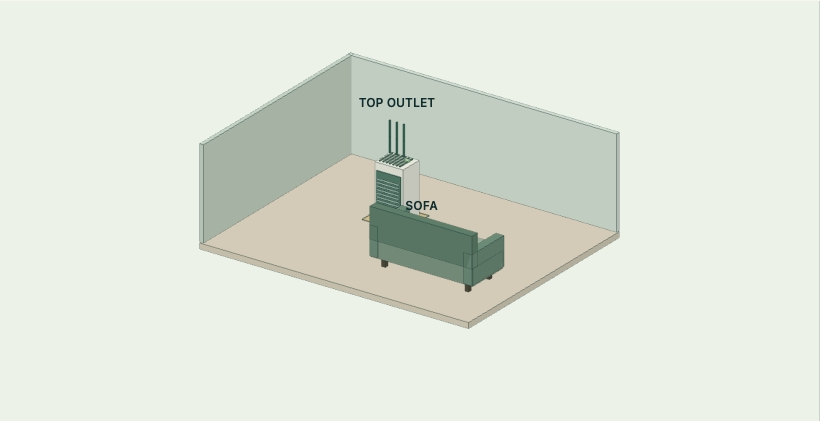
Begin with the space the unit will serve
Portable air cleaners are intended for a room or area, according to the US EPA’s home air-cleaner guide. Measure the relevant floor area and ceiling height, then decide whether doors or an open plan connect it to a larger space. A rated room area is a starting point for comparison, not a guarantee of a particular result throughout an entire home.
Read the airflow path before the styling
Find the intake and outlet in the exact model’s manual. In the placement studio, the original schematic has a rear inlet and a top outlet; another model may use a different arrangement. The EPA advises keeping airflow unobstructed and away from curtains or other objects that can block it. Use the manufacturer’s clearance instructions rather than applying the studio’s illustrative slider as a distance rule.
Compare the wall, corner and furniture views
Rotate the room and switch between an open wall, a corner and the sofa-side position. Look for an inlet facing upholstery or a service panel that would be awkward to reach. The amber overlay is an illustration of access, and the arrows identify outlet direction. They do not model room circulation, particle removal or a tested airflow plume.
Keep the fan setting beside the rating
The EPA explains that particle CADR is commonly measured at the highest fan speed and that lower speeds filter less air. If noise would make you turn the unit down or off, keep that intended setting in the comparison. A specification at maximum speed does not establish the CADR or power draw of a quieter setting unless the maker supplies those figures.
Plan filter replacement before the first purchase
Record the exact purifier model and its replacement filter code. Leave room to remove the panel and filter as the manual requires. A visually similar cartridge or a shared series name is not enough to establish compatibility. The filter finder keeps documented replacement listings separate from the room-sizing result; verify the final part with the manufacturer before ordering.
Recheck the setup in use
After positioning the unit, keep ordinary furniture, curtains and belongings from covering its openings. Use a power log if you want to estimate electricity at your chosen schedule. Particle filtration is a supplement to source control and suitable ventilation, as EPA guidance explains; it does not remove every pollutant or resolve the source of a moisture problem. Follow applicable official guidance for a specific smoke event or building concern.
For the particle-cleaning target that accompanies placement, read how to compare smoke CADR with your room.
Sources
Related equipment and reading
Optional measurement references for the article’s room notes. Use measured dimensions in the room planner to select a purifier; these accessories do not supply a CADR.
As an Amazon Associate I earn from qualifying purchases. These are optional references, not product tests or live offers.
P3 Kill A Watt · P4400
An optional US outlet-energy reference for logging kWh and elapsed time. Check socket, voltage and load limits; power readings do not measure smoke CADR or pollutant exposure.
A US outlet energy meter for the power worksheet. Check electrical limits; measured watts are not smoke CADR or proof of purification.
Govee Bluetooth hygrometer thermometer · H5075
An optional humidity/temperature reference for room notes. It does not measure smoke particles, CO or medical risk.
A humidity and temperature reference for checking a room while using moisture-control equipment. Check placement and Bluetooth range; it does not measure airborne particles or CO.
Room planner · Check exact filter codes · Particle and gas limits